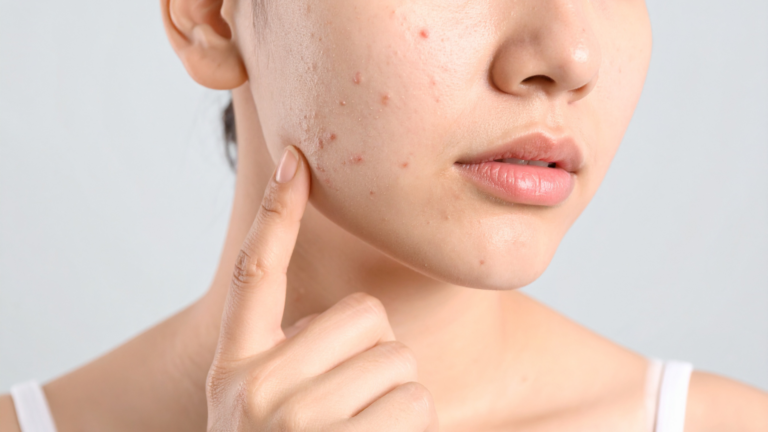
Skin fasting is the practice of eliminating all skincare products for a set period.
There’s a common myth that skincare products make your skin “lazy”, instead depending on the skincare products to do its job. And hence by eliminating the products, your skin’s natural processes are forced to “re-activate”.
An example is the belief that relying on moisturisers will signal to your skin that it no longer needs to produce its own Natural Moisturising Factors (NMFs), but that is simply not true.
In reality, your skin doesn’t forget how to function. Its natural processes are still quietly running in the background, but can often be masked or disrupted by an aggressive skincare routine.

When we talk about a “reset” during skin fasting, we are specifically looking at:
Acid Mantle Recovery: While the skin naturally regulates its pH, chronic use of incompatible products can keep the acid mantle in a state of constant flux. Taking a break from these variables removes ongoing disruption from incompatible products, allowing the skin to maintain its natural pH more consistently.
Surface Calming: Skin fasting is a way to eliminate “sub-clinical” irritation. You might not see a rash, but your skin may be in a state of low-grade chronic inflammation from too many active ingredients.
Sebum Observation: Skin fasting is the only way to see your skin’s genuine oil production levels without the influence of mattifying agents or heavy occlusives.
So.. why do so many people rave over skin fasting then?
The real reason skin fasting “works” for many is because they stop:
Over-exfoliating
Mixing incompatible actives
Constantly switching products
Most improvements seen during a skin fast are not due to doing nothing, but due to stopping what was actively causing irritation.

Instead of “biological retraining,” the real skin fasting benefits are focused on behavioural correction and barrier recovery.
Barrier Resilience: When you give your skin a break, you stop the cycle of over-exfoliation. This allows the stratum corneum (the outermost layer) to allows the stratum corneum to return to a healthier, more intact state, improving your skin’s ability to retain moisture.
Product Audit: If you have been spamming your skin with a ten-step skincare routine, a skin fast acts as a clean slate. It doesn’t “fix” the skin, but through product reintroduction, it allows you to identify which active ingredients were actually necessary and which were causing skin irritation.
Microbiome Balance: The skin is a living ecosystem. Constant application of preservatives found in skincare products can disrupt the diversity of your microbiome. Taking a break from these may help reduce unnecessary disruption to the skin environment.
Skin fasting is not for everyone. If you have a clinical condition like acne vulgaris or eczema, a total fast can be catastrophic.
For the “Product Junkie”: Fasting can be highly effective for those whose skin is perpetually red, “tight but oily,” or stinging. This is usually a sign of a compromised skin barrier from over-layering.
For the Acne-Sufferer: Total skin fasting is a risk. Without salicylic acid or benzoyl peroxide, bacteria can flourish, and breakouts worsen quickly.
For Dry skin / Eczema-suffer: Without moisturisers and/or a topical humectant, the skin may suffer from transepidermal water loss, leading to cracking and skin sensitivity. For eczema patients, stopping moisturisers is detrimental to your skin’s barrier health. In such cases, skin fasting is not just ineffective, it’s counter-productive.
Rather than a total fast, we recommend a Modified Skin Fast. This involves taking a break from relatively harsh actives while keeping the protective essentials.
Examples of such relatively harsh actives include:
L-Ascorbic Acid (Vitamin C): High concentrations can be highly acidic and irritating.
Retinoids/Retinols: These speed up skin cells turnover and can cause significant thinning of the barrier if overused.
High-strength AHAs (Glycolic Acid): These can strip the skin too deeply in a humid climate.
A Gentle, pH-balanced Cleanser: To remove Singapore’s urban pollution and excess sebum production.
Broad-Spectrum Sunscreen: Because UV damage will ruin your skin faster than any “fast” can fix.
By simplifying to just these two, you give your skin the space to breathe and self-regulate without leaving it vulnerable to environmental damage. If you find your skin improves during this simplified period, it is a sign that your previous skincare products were doing more harm than good.
If you are ready to rebuild a skincare routine that actually works for your skin, visit us for a professional consultation to identify your true skin type and baseline needs.
Skin fasting is the practice of temporarily abstaining from some or all skincare products to allow the skin barrier to stabilise without external interference. By taking a break from moisturisers, serums, and active ingredients, individuals can observe their skin’s natural baseline for sebum production and sensitivity.
A skin fast is primarily used as a diagnostic tool to identify skin irritation caused by over-processing or the use of incompatible products, helping to simplify a skincare routine for better long-term health.
The primary skin fasting benefits include the reduction of sub-clinical skin irritation and the recovery of a compromised skin barrier. Constant application of high-strength active ingredients can lead to chronic inflammation. Therefore, taking a break from these variables allows the skin to recalibrate its natural pH and moisture-retention levels.
Additionally, skin fasting can be highly effective for identifying specific product triggers, ensuring that your skincare approach is targeted rather than excessive.
Your skin may suddenly improve when you stop using all skincare products because you have eliminated a condition known as sub-clinical skin irritation. When the skin barrier is overwhelmed by a mismatch of active ingredients or over-exfoliation, it remains in a constant state of low-grade inflammation.
By taking a break from these stressors, you allow the skin barrier to consolidate and the acid mantle to stabilise, which often results in a reduction of redness and a more balanced sebum production.
Essentially, the improvement you see during a skin fast is often the result of removing hidden irritants that were disrupting your skin’s natural equilibrium.
For many in Singapore, the combination of high-strength products and environmental heat can lead to a “reactive” skin type. Stopping your skincare routine temporarily halts this reactive cycle, giving the skin the necessary space to heal its protective outer layer.