The beauty landscape in Singapore is increasingly green. From boutique skincare brands to massive retail chains, skincare products are frequently marketed as “natural” or “botanical.” But for the discerning consumer, a vital question remains: is your skincare routine actually benefiting from the power of plants, or are these products are simply riding a profitable marketing wave?
To separate plant based skincare reality from high-budget hype, we must evaluate vegan alternatives against the clinical standards they aim to replace.
For a skincare regimen to be effective, its plant based ingredients must do more than look good on a label, they must be bioactive. Here is a breakdown of the most popular plant based actives and whether they are backed by beauty science.
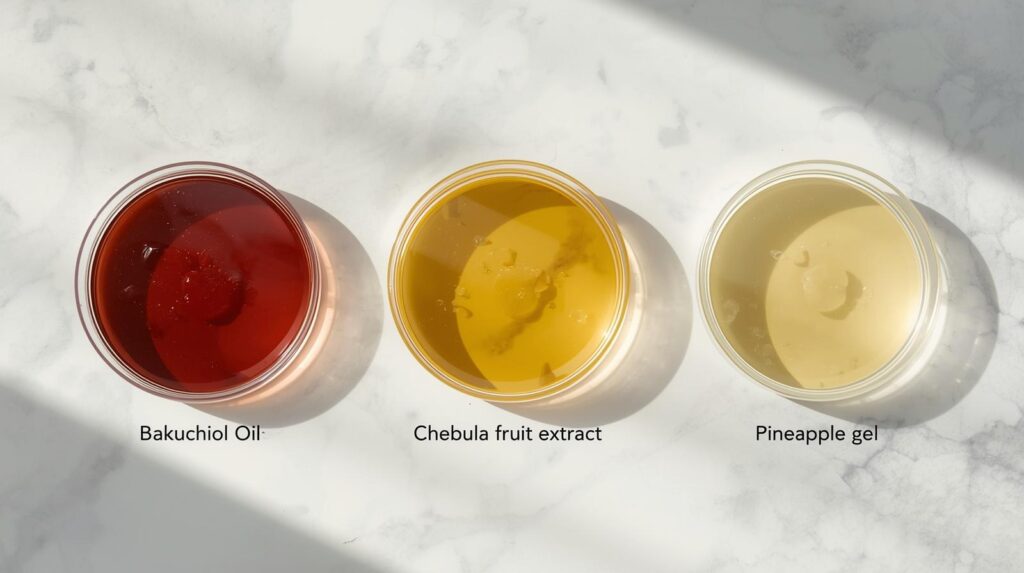
Bakuchiol is often touted as the “crown jewel” of vegan skincare. Unlike retinol, which is a synthetic derivative of Vitamin A, Bakuchiol is a phytochemical derived from the Psoralea corylifolia (Babchi) plant.
What it replicates: It is a functional analogue of retinol. While their chemical structures differ, research shows they induce similar gene expression in the skin.
The Science: A 12-week study published in the British Journal of Dermatology confirmed that Bakuchiol is comparable to retinol in reducing wrinkles and fine lines and hyperpigmentation, but with significantly less scaling and irritation. It is one of the few plant based ingredients that is genuinely “science-backed” rather than pure marketing.
You may have heard of DNA-based skin repair. Phyto-PDRN uses plant extracts (e.g Ginseng) to mimic the wound-healing and anti-inflammatory effects of traditional PDRN.
The Science: While research shows these plant nucleotides exhibit anti-inflammatory activity in a laboratory setting, their biological activity in topical skincare is still being established.
The Reality: Unlike injectable PDRN, which acts as a deep-tissue bio stimulator, topical plant nucleotides rarely penetrate deep enough to stimulate fibroblasts. They primarily function as antioxidants and humectants to support the skin barrier.
Sourced from the Terminalia chebula fruit, this ingredient is becoming a staple in vegan serums.
The Science: It is particularly effective at targeting glycation (the process that causes collagen to become brittle), making it a powerhouse for maintaining skin elasticity.
Commonly found in cleansers, fruit enzymes like Papain (Papaya) and Bromelain (Pineapple) offer a vegan and cruelty free way to exfoliate and smooth the skin.
The Science: These enzymes break down the protein bonds between dead skin cells. They are a considerable alternative to harsh physical scrubs, though their efficacy depends entirely on the pH of the skincare products.
Many popular beauty products in Singapore feature plant based ingredients like green tea or aloe vera as their headline claim. However, the presence of a plant on the bottle does not equate to performance on your skin. In the industry, this is known as “fairy dusting”, adding a microscopic amount of a trendy ingredient just to stick it on the label.
To determine if a vegan product is a functional powerhouse or a marketing myth, you must scrutinise the ingredient lists using these three filters:
In skincare formulation, the preservative Phenoxyethanol is almost always used at a concentration of 1% or less.
The Red Flag: If your plant based extract (like Green Tea or Centella) appears after Phenoxyethanol on the ingredient list, it is effectively useless.
The Reality: For an ingredient like Green Tea (Camellia Sinensis) to provide its documented anti-inflammatory and antioxidant benefits, it typically needs to be present at a concentration of 0.5% to 3%. If it’s at 0.01% (fairy dusted), it won’t even begin to neutralise oxidative stress.
Aloe vera is often listed as the first ingredient, which looks impressive. However, 99% of raw aloe is water.
The Gimmick: Many skincare brands use “reconstituted” aloe powder. They add a tiny pinch of powder to a vat of water and list it as “Aloe Barbadensis Leaf Juice.”
The Reality: Research shows that for aloe vera to actually accelerate skin repair or soothe a compromised barrier, it requires a high concentration of specific polysaccharides. If your moisturiser feels watery and disappears instantly, you’re likely applying expensive water rather than a healing plant based bioactive.
A product being free from parabens, or being vegan and cruelty free is an ethical choice, not a performance guarantee.
The Risk: A “100% plant based” moisturiser that is essentially just water and essential oils can be a disaster for sensitive skin types. Essential oils are highly volatile; without a stable delivery system, they can cause skin sensitivity rather than providing health benefits.
The Solution: Effective plant based skincare should always pair its botanicals with lab-proven “anchors.” For example, a vegan vitamin C serum is only effective if it’s supported by ferulic acid for stability. Without this “active support,” the plant extracts simply sit on the surface and oxidise.
Choosing vegan doesn’t mean you have to compromise on results. The key is to look for skincare brands that prioritise stability and concentration. For example, plant oils rich in essential fatty acids (like Rosehip or Marula) must be stored in opaque packaging to prevent oxidation.
Whether you are looking for collagen production through Bakuchiol or the soothing health benefits of aloe vera, the efficacy of your skincare routine hinges on the integrity of the ingredients.
At SSKINS, we believe that plant based beauty should be as rigorous as clinical dermatology. By understanding the science behind plant based ingredients and learning to decode ingredient lists, you can ensure that your skincare is a functional investment in your skin health.