However, not all post acne marks are created equal. If you look closely in the mirror, you might notice your spots fall into one of two distinct categories: some are bright pink or red, while others appear as dark brown marks.
Unlike true atrophic acne scars, both Post-Inflammatory Erythema (PIE) and Post-Inflammatory Hyperpigmentation (PIH) are forms of post-inflammatory discolouration rather than permanent structural skin damage.
This brings us to the ultimate comparison: PIE vs PIH. Understanding the difference between these two skin conditions is the single most critical step in clearing your complexion, because using the wrong treatment approach can delay your healing or even irritate your skin further.
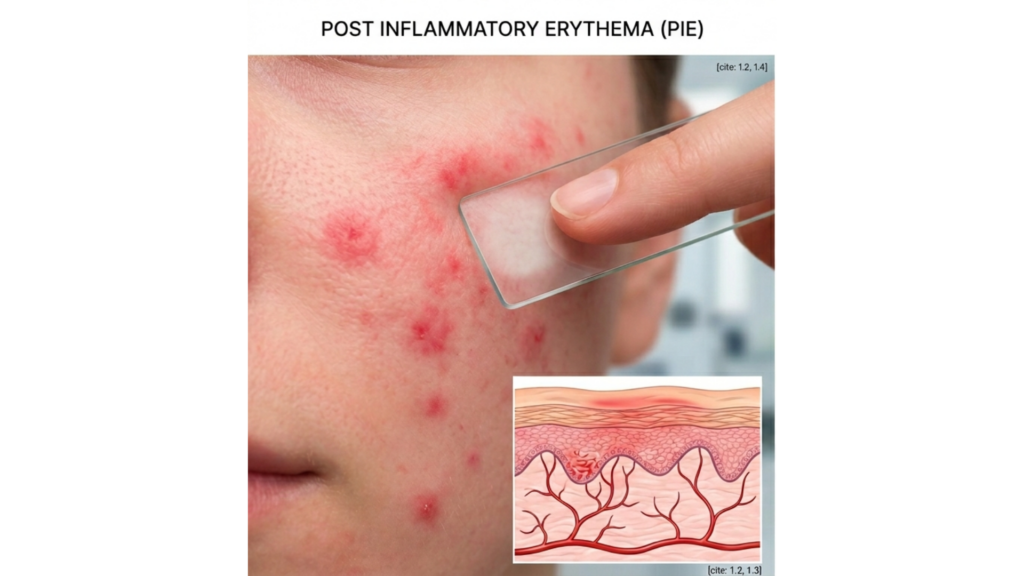
If your post-breakout spots look distinctly pink, red, or even slightly purple, you are dealing with post inflammatory erythema (PIE). Unlike a deep indentation or structural acne scars, PIE is primarily a vascular issue.
When your skin undergoes an inflammatory micro-injury such as a deep cystic breakout, trauma from squeezing a pimple, or localised acne inflammation, the skin responds by increasing blood flow to the damaged zone. This trauma leads to persistent dilation of superficial blood vessels right beneath the surface of the skin.
The superficial blood vessels can remain visibly dilated even after the blemish heals, making them visible through the translucent upper layers of your skin. This creates the localised vascular redness and flush that characterises PIE.
While anyone can experience vascular damage from a blemish, PIE is overwhelmingly common in lighter skin tones. Because fair skin lacks heavy melanin shielding, the microscopic network of broken blood vessels beneath the surface shows through much more prominently.
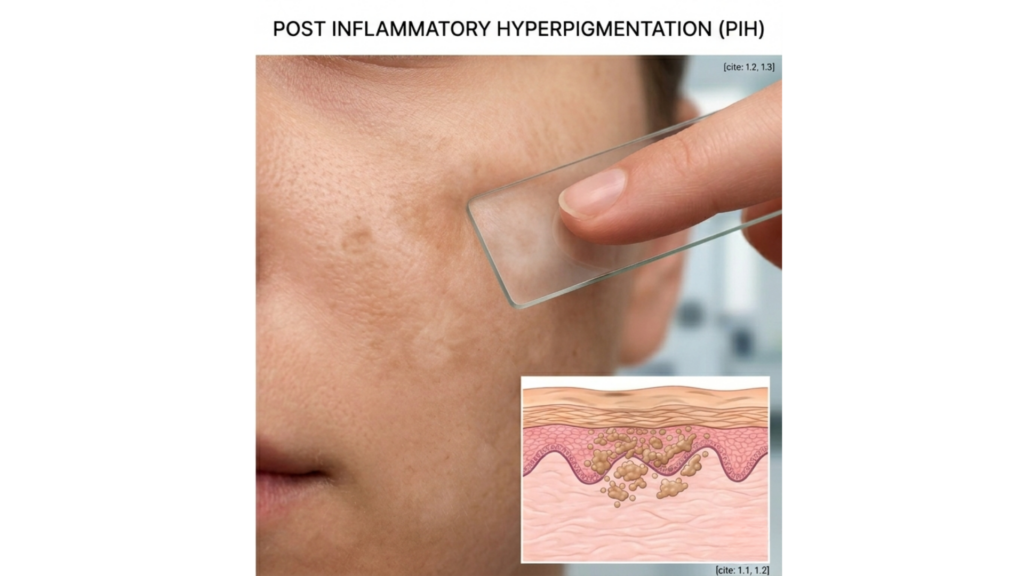
If your leftover marks are tan, dark brown, or almost black, you are likely looking at post inflammatory hyperpigmentation (PIH). Unlike PIE, PIH is primarily driven by excess melanin production rather than visible vascular changes.
When an acne lesion creates trauma in the skin, the inflammatory response triggers your melanocytes (the cells responsible for producing melanin) into overdrive. This localised overproduction results in an accumulation of excess melanin deposited within the surrounding skin cells.
As the skin heals, this concentrated pigment forms flat, darkened spots where the active blemish used to be.
While anyone can develop PIH, it is more prevalent and long-lasting in darker skin tones. Darker skin tones (higher Fitzpatrick skin types IV to VI) naturally possess more active melanocytes.
When inflammation triggers these cells, they produce a heavier distribution of melanin, resulting in deep brown marks that can take months, or even years, to fade naturally without targeted intervention.
Distinguishing between PIE and PIH is actually incredibly simple once you know what to look for. While both originate from skin inflammation, PIE is primarily vascular while PIH is primarily pigmentary. As such, their physical characteristics are completely distinct.
Characteristic | Post-Inflammatory Erythema (PIE) | Post-Inflammatory Hyperpigmentation (PIH) |
|---|---|---|
Primary Visual Appearance | Bright pink, cherry red, or purplish marks | Tan, deep brown, greyish, or black spots |
Root Physiological Cause | Dilated or damaged blood vessels near the skin surface | Excess melanin production triggered by cellular trauma |
The Blanching Test Result | Blanches: The mark temporarily turns white/fades when pressed | Does Not Blanch: The dark spot remains brown under pressure |
Predominant Skin Type | More commonly seen in lighter skin tones | More commonly seen in darker skin tones |
If you are staring at a mark and cannot determine if it is PIE or PIH, one simple way to help differentiate them is the Blanching Test.
Take a clean, clear glass slide, a clear plastic ruler, or even the side of a transparent dropper bottle and press it firmly directly against the post-acne mark for a few seconds. Watch the mark through the clear surface:
If the mark temporarily disappears or turns pale: It is PIE. The pressure forces the pooled blood out of the dilated blood vessels. Once you release the pressure, the blood flows back, and the redness returns.
If the mark stays exactly the same colour: It is PIH. Because the discolouration is caused by solid melanin pigment bound inside the skin tissue, physical pressure will not change its appearance at all.
Because the cellular targets for PIE and PIH are completely different, your daily topical treatment approach must be tailored to address either the underlying blood vessels or the overactive pigment cells.
To get rid of PIE, your routine needs ingredients that strengthen the skin barrier, reduce inflammation, and calm vascular reactivity.
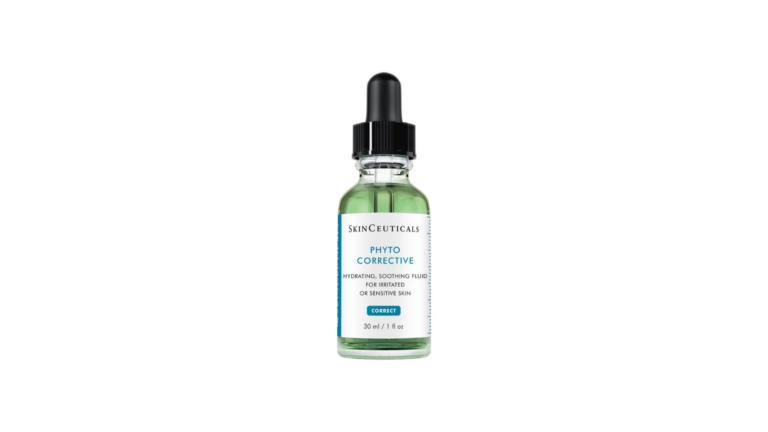
For targeted redness relief, we recommend the SkinCeuticals Phyto Corrective Gel. This ultra-lightweight, oil-free green gel serum is formulated with an intensive 5% phyto-botanical blend of thyme, cucumber, and olive leaf extract. It is designed to soothe visible redness and support hydration in sensitised skin.
To resolve PIH, you must introduce active ingredients that inhibit tyrosinase (the enzyme that creates melanin), disrupt the transfer of pigment to skin cells, and accelerate cellular turnover to shed existing brown marks.
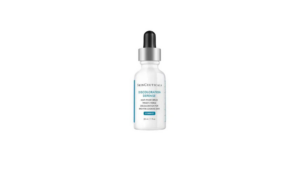
To lift stubborn pigment, we recommend the SkinCeuticals Discoloration Defense. This high-potency, layerable dark spot corrector features a multi-phase formula containing 3% Tranexamic Acid, 1% Kojic Acid, and 5% Niacinamide. In a manufacturer-sponsored clinical study, participants observed visible improvement in uneven skin tone after 12 weeks.
SSKINS is an authorised retailer of SkinCeuticals products. Contact us here to reserve your favourite SkinCeuticals products!
Navigating post-acne recovery can feel daunting, especially in Singapore where the persistent daily humidity and intense UV index can continuously aggravate cellular inflammation.
Whether your post acne marks are red or brown, consistency is your absolute greatest asset. By pairing an understanding of your specific skin condition with advanced, medical-grade formulas from trusted global authorities like SkinCeuticals, visible improvement in skin clarity and tone is achievable with consistent care and sun protection.
The fundamental difference between PIE and PIH is their physiological origin.
Post-Inflammatory Erythema (PIE) is a vascular issue caused by damaged or dilated blood vessels near the surface of the skin, resulting in pink or red marks.
Post-Inflammatory Hyperpigmentation (PIH) is a pigmentary issue caused by an overproduction of excess melanin triggered by cellular trauma, resulting in flat tan, brown, or black spots.
Yes, it is entirely possible to experience both PIE and PIH simultaneously, particularly if you have medium to dark skin tones or if an acne lesion suffered severe structural trauma.
A single healing blemish can leave behind an area of pooled blood vessels (redness) alongside localised excess melanin production (brown marks), requiring a dual-action treatment approach that addresses both vascular inflammation and pigment synthesis.
The natural lifespan of post-acne marks varies drastically depending on your genetics, cellular turnover rate, and sun protection habits.
Without intervention, PIE (red marks) typically fades within a few weeks to a few months as blood vessels naturally constrict. However, PIH (brown marks) can be incredibly stubborn, often taking anywhere from six months to over a year to shed completely from the skin tissue, especially if the pigment has dropped into the deeper dermal layers.
Yes, consistent UV exposure severely aggravates both PIE and PIH.
For PIH, ultraviolet light directly stimulates melanocytes to produce more pigment, causing existing brown marks to darken and become deeply embedded in the skin.
For PIE, UV radiation generates free radicals and heat, which induces vasodilation (keeping the underlying blood vessels widened, inflamed, and bright red for a significantly extended period).
Daily application of a broad-spectrum sunscreen is mandatory to allow both marks to heal.